
Reviewed · CEBU TOURS
Cebu City Tour
Cebu City’s past comes into view quickly on this private, three-hour tour. In one compact outing, you move from a Chinese Taoist temple to a 17th-century ancestral house, then on to the cross linked with Magellan and the country’s oldest Roman Catholic church. It is a brisk introduction to Cebu’s layered identity.
I like the hotel pickup and private vehicle, since Cebu traffic can make short distances feel much longer. I also like the mix of major landmarks and one intimate old home, especially with guides such as Vernie, Angelica, Chen, and Josh praised for bringing the places to life. The drawback is simple: at $38 per person, the tour can feel costly if you want a slow, detailed visit, since several stops last only five to 15 minutes.
Key points at a glance
- Five sharply different stops: You visit the Taoist Temple, Heritage of Cebu Monument, Yap Sandiego Ancestral House, Magellan’s Cross, and Santo Niño Basilica.
- A private car saves time: Your driver keeps the vehicle close while you step out at each site, a useful arrangement in heavy Cebu traffic.
- The schedule is brisk: Most stops last 15 minutes or less, so this works best as an overview rather than a long museum-style tour.
- Guide quality matters: A basic coordinator is included, while a Department of Tourism certified guide is available as an upgrade.
- The price buys convenience: At $38 per person, the value comes from door-to-door transport, a private group, and efficient sightseeing.
- Dress for the basilica: Sleeveless shirts are not permitted at Santo Niño Basilica, so modest clothing is the safe choice.
A fast route through Cebu’s many pasts
Cebu City is not a place where every important sight sits inside one tidy old quarter. The landmarks are spread across the city, and traffic can be trying. This tour’s main trick is practical: you get a private transfer, move between sites by car, and spend your limited time seeing rather than arranging taxis.
The route also gives you a useful way to understand Cebu. The Taoist Temple reflects the city’s Chinese community. The ancestral house shows domestic life from an earlier period. Magellan’s Cross and Santo Niño Basilica bring in the Spanish and Catholic story. The Heritage of Cebu Monument ties several major episodes together in one compact artwork.
You should expect a quick pace. The listed stops add up to about 55 minutes of scheduled sightseeing, with the rest of the three-hour outing used for driving, arrival, departures, and traffic. That is enough to get your bearings and see the main markers, but not enough for long contemplation at every site.
A few more Cebu day trips to weigh up
- Cebu City: Whale Shark Swimming & Kawasan Falls Canyoneering
★ 4.7 · 665 reviews - Cebu Moalboal: Kawasan Canyoneering Adventure with Lunch
★ 4.9 · 630 reviews - Cebu City: Bohol Countryside Tour with Loboc Cruise Lunch
★ 4.5 · 488 reviews
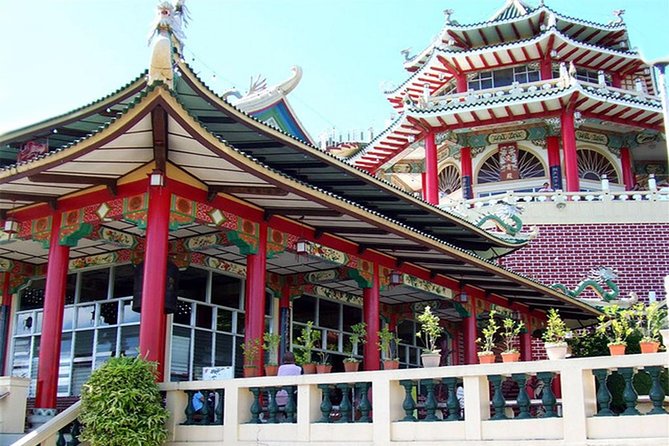
Taoist Temple: Cebu’s Chinese connection
The first stop is the Taoist Temple in Beverly Hills Subdivision. Cebu’s Chinese community built it in 1972, giving you a modern religious site with a strong cultural link to the city’s Chinese residents.
The temple is a useful counterpoint to the Spanish and Catholic landmarks later in the morning. It reminds you that Cebu’s story is not only about colonial churches and explorers. You get about 15 minutes here, and admission is included.
That short visit is enough for a look around, but it may feel limited if you hoped to study the temple in detail. Your guide can give the stop meaning by explaining its place in Cebu’s Chinese community. This is one reason I would choose the Department of Tourism certified guide upgrade if cultural context matters to you.
The setting also helps break up the older colonial material. You are not simply moving from one church to another. Instead, the route introduces several communities and belief systems that have shaped the city.
Heritage of Cebu Monument: history in one crowded scene
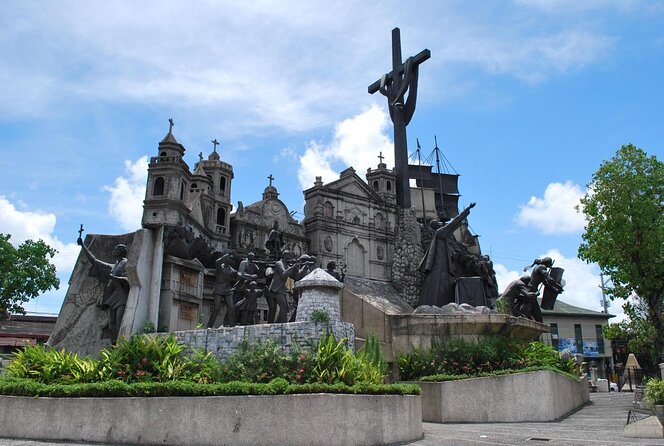
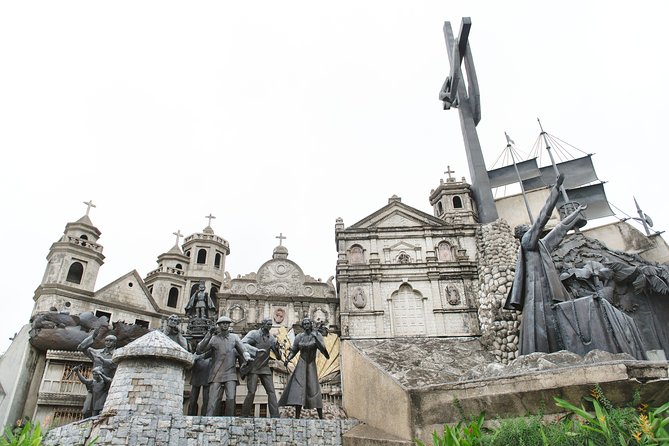
The Heritage of Cebu Monument is a tableau made from concrete, bronze, brass, and steel. It presents scenes connected with important events and structures from Cebu’s past.
You get only about five minutes here, so think of it as a photo and orientation stop. The monument packs a lot into one view, and your guide’s explanation is especially useful because the figures and scenes can be hard to interpret on your own.
This is probably the tour’s clearest example of the tradeoff between coverage and depth. You can see a striking public artwork and hear the basic story, but you will not have time to inspect every section. If you enjoy visual history, pay close attention during the explanation rather than treating it as a quick photo break.
The stop works well beside the next one. The monument presents Cebu’s past in public form, while the Yap Sandiego Ancestral House lets you see how one family lived within that past.
Yap Sandiego Ancestral House: a closer look at domestic life
The Yap Sandiego Ancestral House was built sometime between 1675 and 1700. It was originally owned by Don Juan Yap, a Chinese merchant, and his wife, Dona Maria Florido.
This is the most personal stop on the route. Monuments and churches tell large public stories, but an old merchant’s house gives you a sense of rooms, furnishings, family life, and the way Chinese and Filipino influences met in Cebu. You get about 15 minutes here, admission included.
The house is valuable because it slows the story down, even if only briefly. Instead of hearing about rulers, expeditions, and institutions, you are looking at a home connected to ordinary patterns of life from an earlier era.
Do not expect a long house tour at this pace. Fifteen minutes goes quickly, especially if the guide is explaining the building’s age and former owners. Still, this is one of the stops I would not skip. It gives the city’s history a human scale.
Same island, a completely different kind of day:
- Canyoneering Experience in Kawasan Falls with Lunch
★ 5.0 · 440 reviews - Cebu: Oslob Whale Sharks, Tumalog Falls & Sardine Snorkeling
★ 4.3 · 343 reviews - Cebu: Whale Shark Swim and Kawasan Canyoneering Tour
★ 4.6 · 318 reviews - Cebu: Oslob Whale Sharks, Moalboal Sardine Run & Turtles
★ 4.5 · 266 reviews
Magellan’s Cross: a famous marker with a complicated story
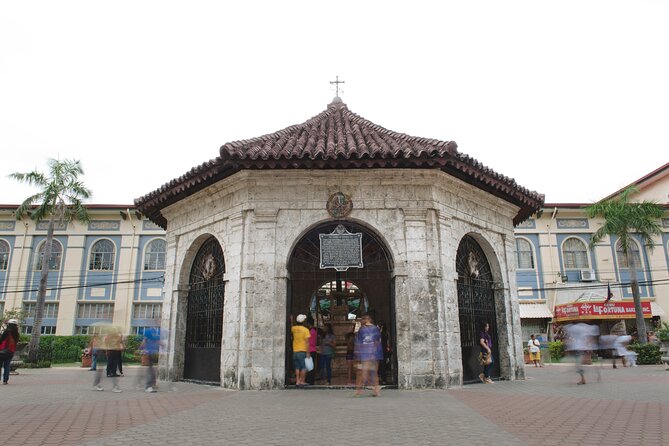
Magellan’s Cross is linked to Ferdinand Magellan’s arrival in Cebu on March 15, 1521. Portuguese and Spanish explorers planted the Christian cross under Magellan’s orders.
You spend about five minutes here, so the visit is brief and focused. The cross is important because it marks the beginning of a major chapter in the Philippines’ colonial and Christian history. It also prepares you for the Santo Niño Basilica next door or nearby in the same historic area.
The short stop means you will likely get a quick explanation and time to see the marker rather than a long discussion. That is fine for a first visit, especially if you are fitting the tour into an arrival day or a tight schedule.
I would listen closely to the guide here. The object itself does not take long to see, but its meaning comes from the events around it. Without context, this can feel like a photo stop. With a good guide, it becomes a useful marker for understanding how Cebu’s religious and political story began to change.
Santo Niño Basilica: the tour’s main religious site
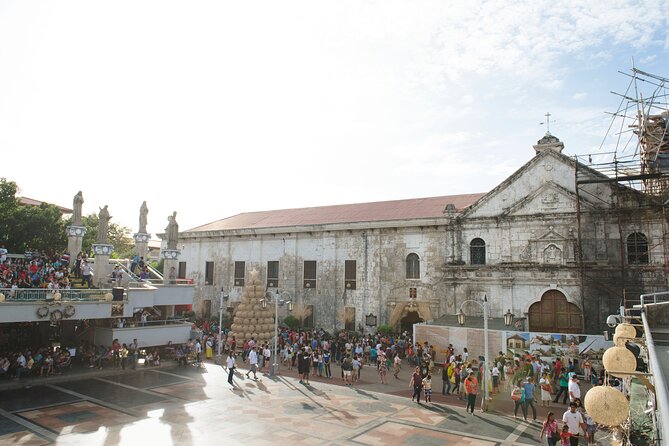
The Basilica Minore del Santo Niño de Cebu is described as the oldest Roman Catholic church in the Philippines. It was built where the image of the Santo Niño de Cebu was found during Miguel Lopez de Legazpi’s expedition.
This is likely the most important stop for visitors interested in Cebu’s Catholic tradition. It connects the earlier arrival of Magellan with the later Spanish expedition and the continuing devotion to the Santo Niño.
You get about 15 minutes, which gives you time to see the basilica and absorb its importance. The visit is not designed as a full religious tour or extended architectural study. It is a concise introduction to one of the country’s most important Catholic sites.
Dress carefully. Sleeveless shirts are not allowed, so wear covered shoulders or bring something light to put on before entering. This is a small detail, but it can determine whether your visit goes smoothly.
The basilica also shows why a certified guide can be worth the extra cost. A coordinator can get you from place to place, but a Department of Tourism certified guide is better suited to explaining religious meaning, colonial history, and the connection between the basilica and the earlier stops.
Why the private vehicle matters in Cebu
The transport arrangement is one of the strongest practical features. You receive hotel pickup and drop-off, round-trip private transfer, and transport by private vehicle. You do not have to find a taxi at each stop or spend the morning negotiating routes.
One review described the benefit clearly: with a driver, the two people in the group could jump out, visit a site, and get back into the vehicle while traffic carried on around them. That matters in Cebu City, where a short route on a map may not translate into a short ride.
The tour is private, so only your group participates. That gives you more control than a large coach outing, although the short fixed schedule still limits how long you can stay at each place.
Pickup is also useful if this is your first day in Cebu. One guest used the half-day tour on the day of arrival and found that the compact route still felt full. I would leave enough room around your flight plans, though. The tour lasts about three hours, and traffic conditions can affect the timing.
Guide choice: coordinator or certified guide
A tour coordinator is included, and the experience can also be upgraded to a Department of Tourism certified guide. That distinction is important here because the sights are not all self-explanatory.
A coordinator can help keep the route moving and make sure your group reaches each stop. A certified guide should give you more historical and cultural explanation, which is especially useful at the Heritage of Cebu Monument, Magellan’s Cross, and Santo Niño Basilica.
Named guides connected with especially positive experiences include Vernie, Angelica, Chen, and Josh. Assignments can vary, so you should not assume one particular person will lead your tour. Still, the feedback points to a clear pattern: guide commentary can make the difference between a basic transport loop and a meaningful city introduction.
Angelica was specifically praised for bringing the sites to life, while Chen was described as explaining what you needed to know during a three-to-four-hour visit. Those details support paying extra for the certified guide if you want more than a driver and a series of quick stops.
Is $38 a fair price?
At $38 per person, this is not the cheapest way to look at a few central Cebu sights. The route itself is short, and several stops last only five minutes. One fair criticism is that Cebu does not offer a long list of major sights within this particular half-day circuit.
The price makes more sense when you value time and transport. It includes hotel pickup and drop-off, private round-trip transfer, a private vehicle, all listed activities, taxes, fees, and a tour guide. You are paying to avoid piecing the route together yourself.
The value improves for two or more people who want a private outing rather than a shared group. It also improves if you are new to Cebu, have only a morning free, or are uncomfortable handling city traffic and separate taxi rides.
The value is weaker if you already know the historic center, prefer to wander slowly, or only want to see one or two of the sites. In that case, the short visits may not justify the cost. The tour is best understood as a convenient overview, not a full-day examination of Cebu’s past.
Who should book this Cebu City tour?
I would recommend it to first-time visitors who want a quick introduction without spending the day planning routes. It suits couples, families, and small groups who appreciate a private car and hotel service.
It also works well as an arrival-day activity, provided your schedule allows plenty of time around the flight. The tour gives you a first look at Cebu’s religious, Chinese, colonial, and domestic heritage in one outing.
History-minded visitors should choose the certified guide upgrade. The schedule is too tight for you to gather all the meaning from the buildings and monuments alone.
I would be more cautious if you want long visits, detailed photography time, or a relaxed morning. The five-minute monument stop and five-minute Magellan’s Cross visit are particularly short. You will see a lot, but you will not linger.
The tour has a 4.6 rating from 11 reviews, with 91 percent recommending it. The praise centers on transport, quick communication, and guides who explain the sights well. The main reservation is price relative to the limited number of stops, a fair point to keep in mind.
Practical details before you go
The experience lasts approximately three hours and includes mobile ticketing. Confirmation is provided at booking, and group discounts are available.
Food and drinks are not included, so plan to eat before or after the outing. The itinerary is packed enough that you should not expect a meal break during the tour.
Children must be accompanied by an adult. The child rate applies only when sharing with two paying adults. Most people can participate, but the supplied information does not give a more detailed accessibility description.
Free cancellation is available if you cancel at least 24 hours before the local start time. Cancellations or changes made within 24 hours are not accepted for a refund. The activity also requires a minimum number of participants, and if that minimum is not met, you are offered another date or experience, or a full refund.
Should you book it?
Book this tour if you want efficient door-to-door sightseeing and a private introduction to Cebu City’s main historic and religious markers. Choose the Department of Tourism certified guide upgrade if you care about the stories behind the sites, not just quick photographs.
Skip it if you want a slow heritage walk or feel $38 is too much for a three-hour overview. The itinerary is short, but it is thoughtfully varied, and the private car solves a real Cebu problem. For a first look at the city, especially on a tight schedule, that convenience can be worth paying for.
FAQ
How long does the Cebu City tour last?
The tour lasts approximately three hours.
What is the price of the tour?
The listed price is $38 per person.
Is hotel pickup included?
Yes. Hotel pickup and drop-off are included, along with round-trip private transport.
Is this a private tour?
Yes. Only your group participates in the private activity.
Which sights are included?
The tour visits Taoist Temple, Heritage of Cebu Monument, Yap Sandiego Ancestral House, Magellan’s Cross, and Basilica Minore del Santo Niño de Cebu.
Is a guide included?
Yes, a tour guide or coordinator is included. You can upgrade to a Department of Tourism certified guide.
Are food and drinks included?
No. Food and drinks are not included.
Can I cancel for a full refund?
Yes, if you cancel at least 24 hours before the experience’s start time. Cancellations made less than 24 hours in advance are not refunded.
Just added around Cebu
- Kawasan Falls Canyoneering Transfers from Cebu with Lunch★ 5.0 · 3 reviews
- Cebu: Oslob Whale Shark, Simala Church & Ka Treasure Argao★ 4.8 · 3 reviews
- Cebu: Pescador Island, Sardines run and Kawasan Canyoneering★ 5.0 · 3 reviews
- Private Kawasan Falls Canyoneering w/ Lunch★ 5.0 · 3 reviews
- Cebu: Moalboal Snorkeling and Kawasan Falls Canyoneering★ 5.0 · 3 reviews
- Cebu: Mantayupan Falls, Hermit’s Cove & Bojo River Eco Tour★ 4.8 · 3 reviews
- Cebu & Lapu-Lapu City Tour With Lunch at House of Lechon★ 5.0 · 3 reviews
- Cebu: Inambakan, Kawasan, and Mantayupan Waterfalls Tour★ 3.7 · 3 reviews
Cebu Tours, compared.

Cebu City: Whale Shark Swimming & Kawasan Falls Canyoneering
Read our review →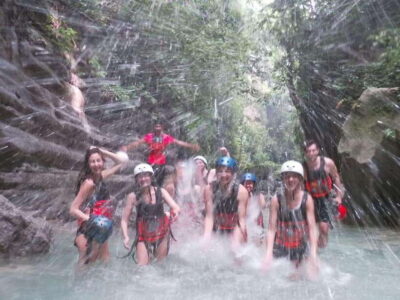
Cebu Moalboal: Kawasan Canyoneering Adventure with Lunch
Read our review →
Cebu City: Bohol Countryside Tour with Loboc Cruise Lunch
Read our review →
Canyoneering Experience in Kawasan Falls with Lunch
Read our review →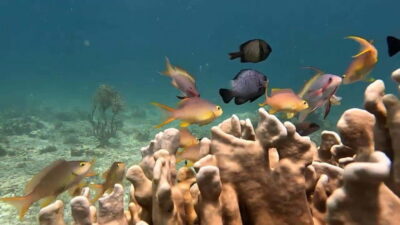
Cebu: Oslob Whale Sharks, Tumalog Falls & Sardine Snorkeling
Read our review →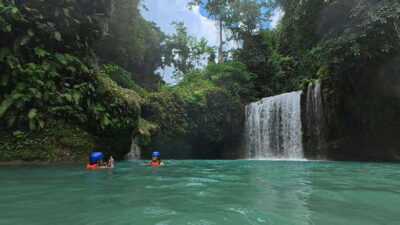
Cebu: Whale Shark Swim and Kawasan Canyoneering Tour
Read our review →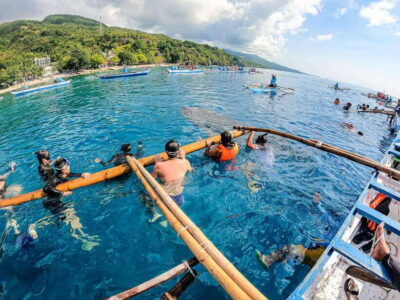
Cebu: Oslob Whale Sharks, Moalboal Sardine Run & Turtles
Read our review →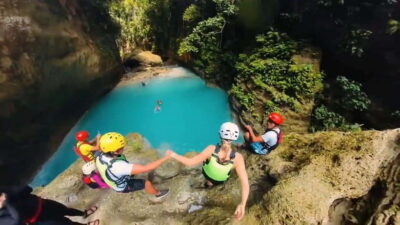
Cebu: Kawasan Falls Canyoneering Tour with Ziplining & Lunch
Read our review →Browse the lists this tour appears in